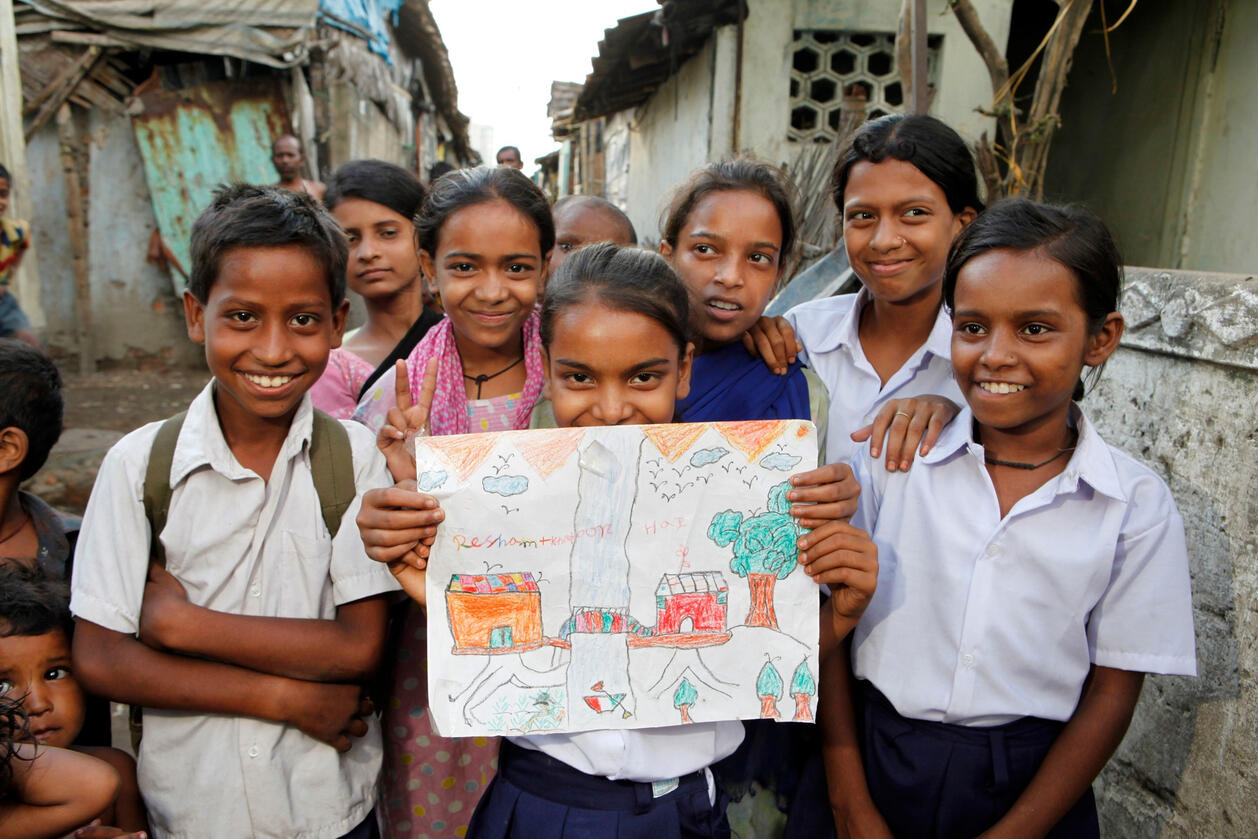
If Hope Flickers Out
A campaign for Tiljala SHED, an Indian NGO that is empowering slum communities in Calcutta
“I would have suffered a similar fate, maybe studied till the third or fourth grade and been married off at the age of 13 or 14.”This is how Sonam Khatoon described what would have happened to her without the support of Tiljala SHED, the NGO that has sponsored her education since she was twelve. Sonam is twenty years old, unmarried, and studying in college. Her older sister, Rehana, is thirty-five and met the fate that Sonam described: Rehana was married at fourteen and now has four children.Sonam and I are sitting in a school courtyard in Kolkata, India, formerly known as Calcutta. Come join us; there’s only room for one more chair, but the space here is idyllic compared to what you’ll find just outside. Above us stands one of the few trees you’ll see in this neighborhood, shading us from the tropical sun. The school walls are painted with bright airplanes and trains, labeled instructively in English. Curious children peep out from the school doorway as we conduct the interview. Give them a wave in exchange for a giggle.Rehana is with us too, wearing an exhausted but content smile. Sitting on her lap is little Anaya, her four-year-old daughter. Anaya turns to look at you, her ears poking out of her messy hair, which sprouts from the top of her head in a little black tuft. Rehana and Sonam frame their faces with black headscarves brightened by floral motifs, and Rehana’s hands rest comfortably on Anaya’s healthy shoulders.
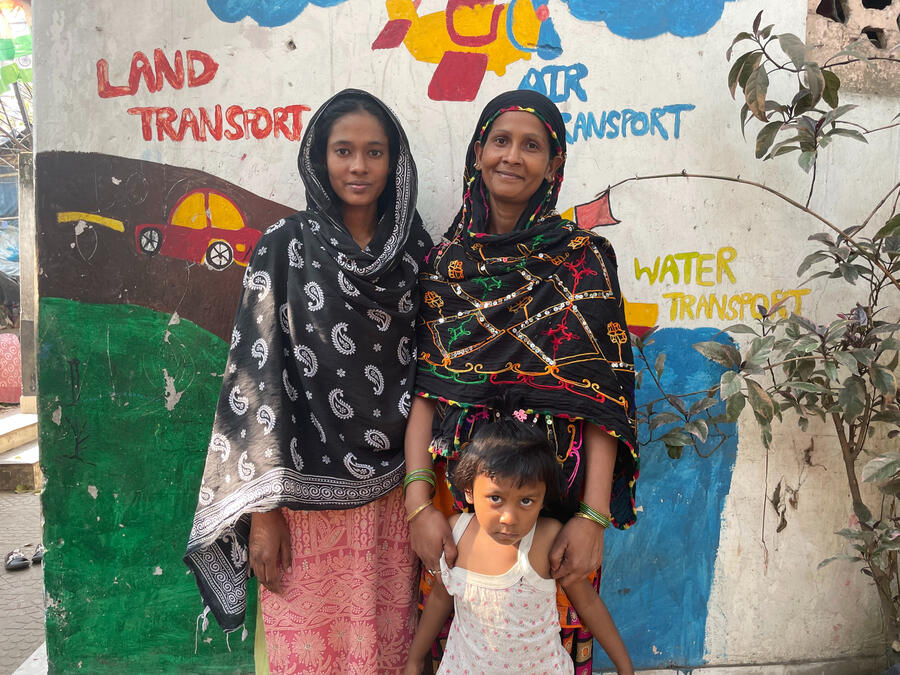
Sonam (left), Rehana (right), and Anaya (bottom).
Now let’s go for a walk. Anaya hops down from Rehana’s lap and leads the way across the courtyard. As we pass the school center, peek inside and you’ll see a plump beaming Santa on the wall, a chalkboard where the teacher is writing out the Bengali alphabet, and rows of young children sitting cross-legged on the carpet, notebooks flopped open on their laps. One of them will offer a little hand, pleading for a fist-bump. Your heart will swell when you see the excitement dance in her bright eyes.Step through the hallway, past the neat row of flip flops and knock-off Crocs that the children take off before entering the classroom. Watch as Anaya tries on one of the older children’s sandals, still too big for her; but in a few short years she will proudly place her own next to the rest. Sonam began studying at this school eight years ago, and today, her nephew and Anaya’s older brother, Arif, studies here too. Anaya is eager to follow in his footsteps.
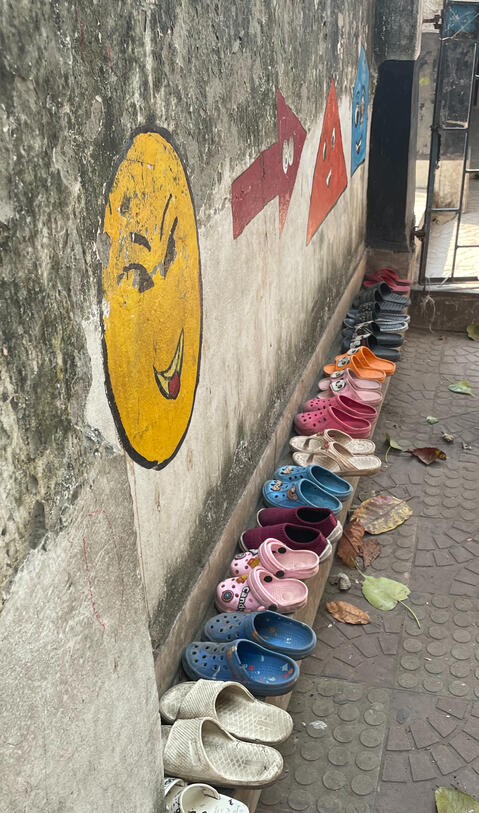
The shoes of some of Tiljala SHED's 800 students lined up outside the Topsia school center.
Come to the gate at the end of the hallway. Open that and step down onto the pavement. You are now standing in the middle of Topsia Mazdoorpara, one of Kolkata’s 5,000 slums.Follow Anaya down the narrow, dusty lane that she walks every day. Excuse yourself as you pass three-year-olds toiling by with jugs of water half their size. Step past the children seated on mats trimming flip flops, swat away the flies, and see the bright headscarves wave in the wind in front of the shanties. Three of these hovels used to be heroin dens, and older students like Sonam remember walking past them as little children on their way to school. But today, Anaya is safe from them, because the community, along with help from Tiljala SHED, organized a sting operation, and the dens haven’t returned since.The shanties are packed tightly together in two rows, one on either side of the lane. They lack plumbing, drinking water, and ventilation, and by May, they are oppressively hot. One of these huts belongs to Sonam and her parents. Step inside, past the wood-fired oven, and you enter a single room dominated by a bed.
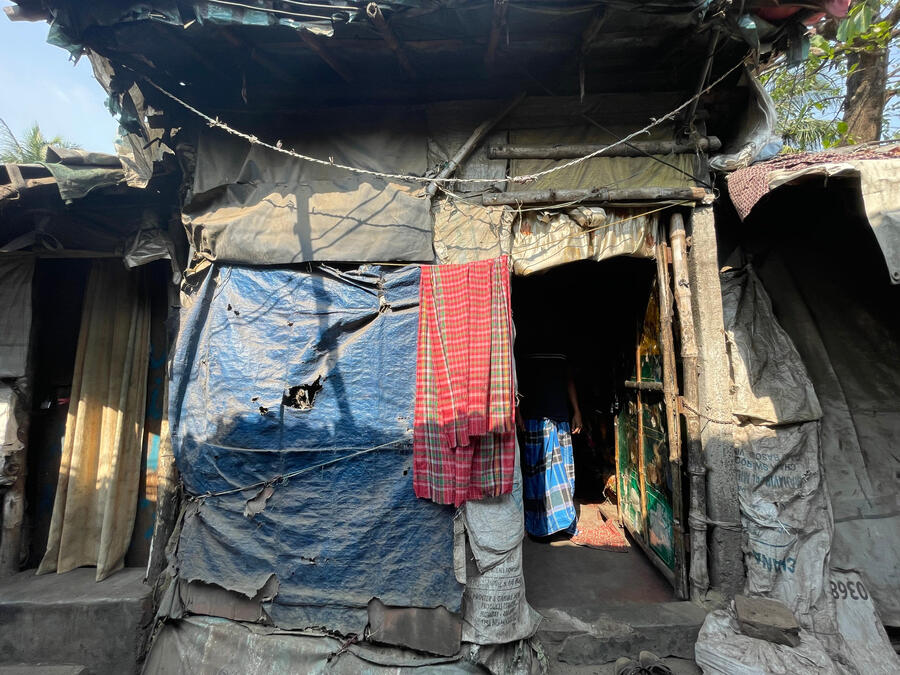
A hut in the Topsia slum. Seven people live in each hut, on average.
Growing up, Sonam lived with five other people in this room, ten feet wide by fifteen feet deep, the same room where father was born and raised. Both of her parents are illiterate, and as a child, Sonam supplemented their meager income by making sandal straps after school. Their finances are strained still further by her father’s hospital bills. Two years ago, his feet were crushed by a falling stone at the marble factory, and since then he has been unable to work.Brush aside the mosquito net and make your way to the rickety porch in the back, which the family uses for bath and bathroom. Your eyes will begin to water at the noxious stench. Below you, a sewage canal oozes by. Human waste flows into it from the bamboo pipe in front of you and from the pipes of the surrounding shanties.Now you understand why only the most destitute people in Kolkata live here, in the slum of Topsia, where no one would even want to walk. Topsia is a long, narrow island in the middle of this canal, as if cut off from the rest of the world by a putrid moat. The island is forty feet wide, half a mile long, and home to Sonam, Anaya, Rehana, and their 7,000 neighbors.In December of 2024, Sonam found herself waist-deep in this foul water.Just months after her father suffered the injury that cost him his livelihood, their hut caught fire, and she was bringing the few belongings that she was able to snatch from the flames to safety, by wading through the canal. Everything she left behind burned to ash. The fire department is located less than a mile away, but they arrived late, partly because the trucks couldn’t pass through the slum’s narrow lane. So they parked on the banks of the canal and sprayed its polluted water onto the flames.For an entire month afterward, Sonam and the hundred other families who had lost their homes received tireless support from Tiljala SHED. Staff and volunteers provided them with three meals a day. They resupplied them with essentials like mosquito nets, kitchen utensils, blankets, clothing, and notebooks for the students, until the families were able to rebuild their huts or find permanent housing. Slowly, people patched together the charred tatters of their former lives.
Walking through the Topsia slum. The woman speaking is Sultana Khatoon, a Tiljala SHED student from this community who will be studying nursing in Germany thanks to a sponsorship.
Despite all the hardship she has endured, Sonam remains optimistic, in no small part because she has been spared her older sister’s fate of child marriage. When Tiljala SHED began its outreach in 1987, the average marriage age of girls was thirteen. Today, it’s nineteen. “That is one of the most beautiful things that has happened to this community,” Sonam said. It’s little wonder that she is in no hurry to tie the knot, given the literal constrictions on a woman’s freedom that often come with marriage here. I spoke to another young woman who casually mentioned that when she gets married, she won't be able to leave the home without her husband's permission.Sonam is one of over 250 students that Tiljala SHED has enrolled in college, out of a total of nearly 20,000 students that they’ve admitted into schools over the decades. “After studying, I will get a job, shine, have a bright future,” Sonam said. “I am very hopeful.” After school, she helps tutor her sixth-grade nephew, Arif, giving him the academic assistance that she never received from her parents. Arif is a precocious student who participates in Tiljala SHED’s science fairs and makes his mother, Rehana, beam with pride. Rehana hopes Arif’s hard work will secure him a stable job and help lift the family out of poverty.Tiljala SHED is creating hope for some of India’s most underprivileged people. “Tiljala SHED isn't an organization separate from the community,” said Shafkat Alam, the head of the NGO. “It’s a part of the community. It runs in their blood.”But this hope may not survive for long. Tiljala SHED relies on donations, and their current round of long-term funding will expire in June of 2026. The other school center in Topsia has already shut down, in need of repairs that Tiljala SHED can’t afford. Funding is a constant source of anxiety for Shafkat, but just one long-term grant could free him from the time-intensive work of fundraising and allow him to focus all his efforts on the 3,000 families that Tiljala SHED serves. Eighty percent of all funds Tiljala SHED receives go directly to their outreach programs like educating Sonam; the remainder are set aside for overhead costs such as office rent and administrators’ salaries.
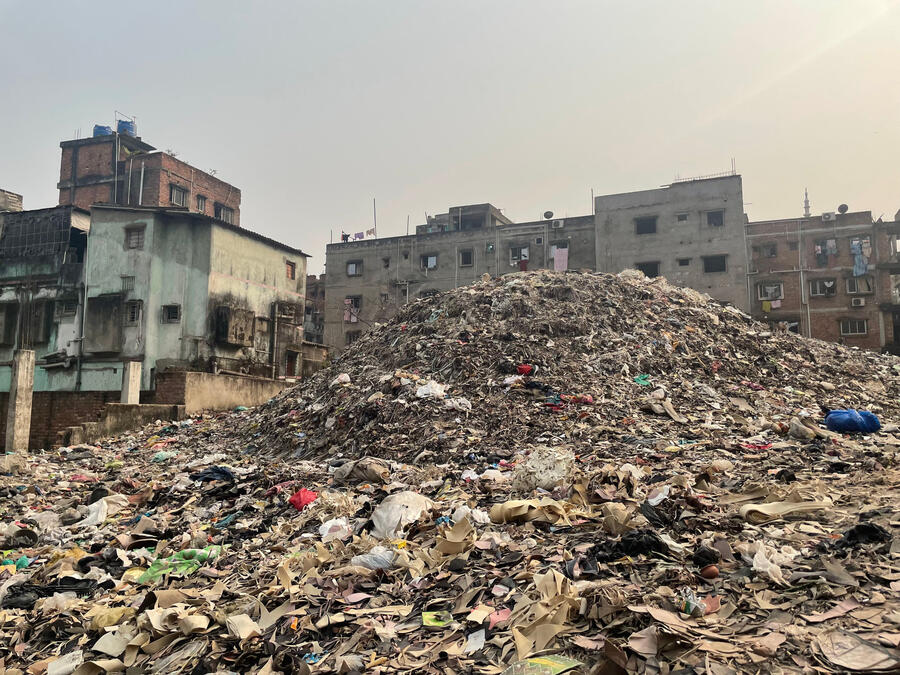
A rubbish heap near the Tiljala SHED girls' library. People known as 'rag pickers' sort through rubbish heaps like this in order to sell recyclables for $2-$4 USD per day.
If Tiljala SHED runs out of funding, Sonam may be forced to drop out of college. She might then get married sooner than she’d hoped, or start working as a maid servant and spending less time tutoring Arif. The next time a fire burns through the slum (there have been four in the past ten years), she will have only the government’s insultingly meager support to rely upon. After the most recent fire, all the government provided to the families who’d lost their homes were two bamboo poles and a sheet of plastic.At least Sonam has had the benefit of eight years of Tiljala SHED’s education in her life. But what about little Anaya, who hasn’t yet had the chance to have any? Will she end up in the same situation as her mother, married off early, educational opportunities closed to her? Will the hard-won progress that gives Sonam hope come to a sudden halt?
Sonam’s story is one of many I heard during my week conducting interviews with the people served by Tiljala SHED. Without this organization, Afreen would never have been able to defy her family’s narrow gender expectations by becoming the first female lawyer from her community. She now serves as an advocate in the Calcutta High Court and described Tiljala SHED as “a ray of hope light.”Moidul would still be engaged in the profession that he began when he was orphaned at age seven: digging through trash for plastic to sell to middle men and recyclers at exploitative rates. When Moidul was twenty-three, Tiljala SHED helped him secure a micro-loan for the rickshaw that he now drives in order to support his family, having maintained his pride that he has never asked for a handout.Child labor would return because parents wouldn’t be able to cover basic school expenses, and the children I saw in the lane trimming flip flops for 0.15 cents each would be doing this all hours of the day, instead of only after school.And more wives would find themselves in the unconscionable situation of the woman whose name I never learned, because her drug-addicted husband threatened to kill her if she spoke to me. Reports of domestic violence have significantly decreased thanks to the female self-help groups that Tiljala SHED sponsors, which empower women in the community to confront abusive husbands.The conditions in Topsia are nothing short of heart-rending, and this is just one of the seven slum communities that Tiljala SHED serves. I visited all of them, saw them, smelled them. When they made me weep in public, children approached me — a grown man from a different world — to ask me shyly what was the matter. As grim as these conditions are, however, we must bear in mind that they have gotten substantially better, thanks to the dedication of Tiljala SHED and the resilience of the people they fight for. But if Tiljala SHED doesn’t get more funding, then all this hard-won progress will crumble to ashes, like Sonam’s home.You can help prevent that, if you want to.For $10, you can give a durable book bag and school uniform for a child like Anaya. For $40, you can cover the educational expenses of a high school student for a month, like Anaya’s older sister, Afsana. And for $180, you can fund a child’s education for an entire year, like their brother, Arif.
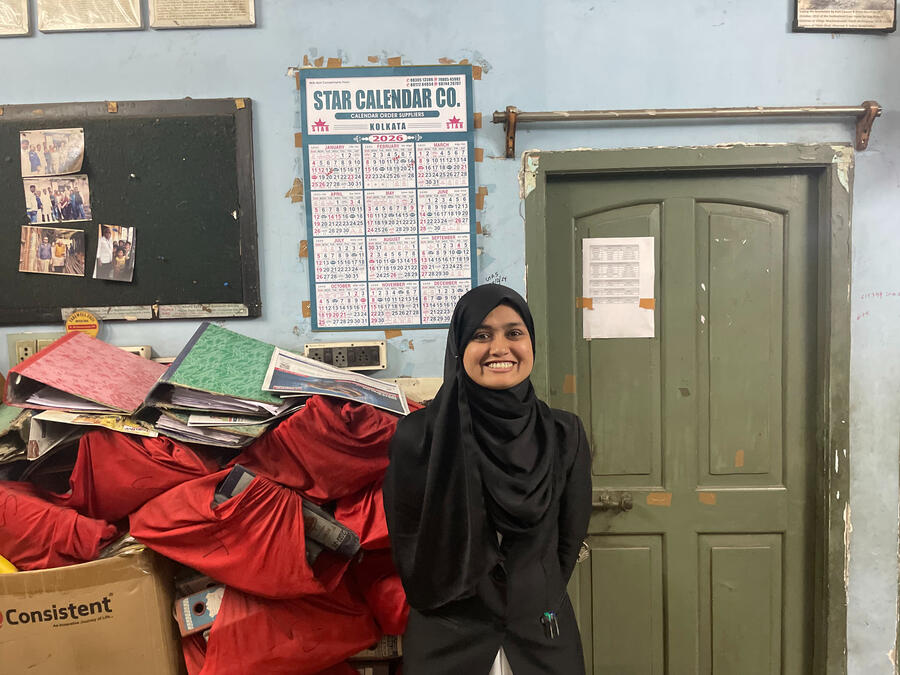
Afreen Tarannum's dream of becoming a lawyer would have never come true without Tiljala SHED. She now serves as an advocate on the Calcutta High Court, after having received personal tutoring for the bar exam by the head of the NGO.
I hope you understand the importance of Tiljala SHED’s education program for Sonam and her family, a fragile respite from the chaos of the surrounding community and a quiet haven of study amidst the din of Kolkata, which rings through the streets just across the canal. I hope that in a few short years, little Anaya will be able to play with her fellow students beneath that slender courtyard tree, which shades them from an unforgiving world. When it comes time for her to place her little shoes next to her brother’s in that neat row that lines the hallway, I hope, desperately, that the school will still be there.Will you help us keep this hope alive?
Share
Help spread the word about Tiljala SHED by sharing this page with your friends and family.
Written by Connor Hocking, an American who spent a week in Kolkata volunteering with Tiljala SHED in February, 2026.You can contact Connor at [email protected]
Shatyam, one of Tiljala SHED's students, and Connor, the author.